Showing posts with label marketing. Show all posts

Monday, February 13, 2012

Featured Project: Marketing for Ryan Companies/Hayden Ferry Lakeside

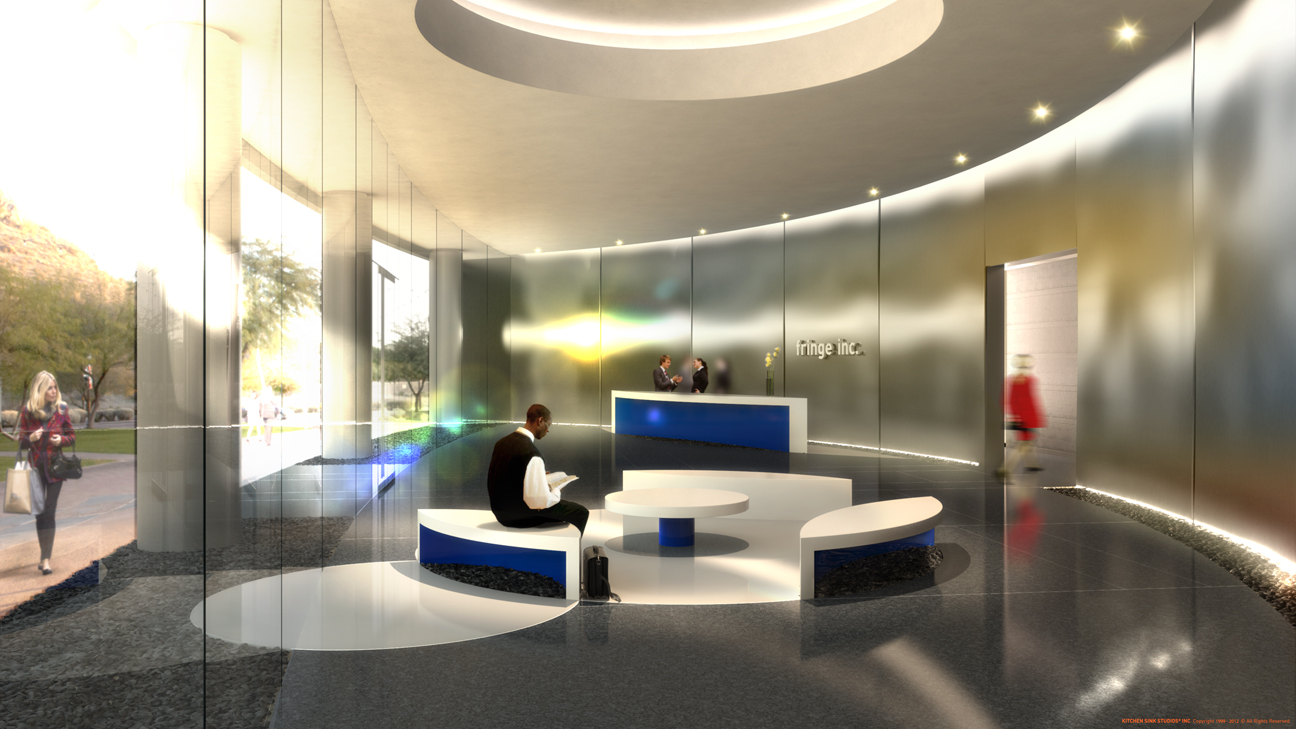
Our latest Featured Project is the creation of new marketing materials for a Phase III office building at Hayden Ferry Lakeside in Tempe.


The Kitchen Sink Studios team used an outstanding design by DAVIS Architects and an existing computer model (above) to create four compelling renderings to be used for direct marketing and pre-leasing of the new tower. Some significant revisions to the design of the building and lobby (including raising the ceiling by four feet) were accomplished on the fly, making the project a bit more challenging. 

The resulting photo-realistic renderings provide an absolutely stop-on depiction of what the tower will look like when complete, allowing Ryan Companies to attract large commercial tenants. Additional enhancements in the future could include adding a tenant name to the tower for a more direct marketing approach.


Molly Ryan Carson, Vice President of Development at Ryan Companies, said of our work "We will definitely keep you in mind for future projects...working with you and your team has been a wonderful experience. I would love to do it again."

We always enjoy taking something that's in the conceptual phase and bringing it to life so that a story can be told. With the photorealistic marketing materials we created, we believe Ryan Companies will have great success in finding tenants for this exciting new project. 

Wednesday, December 1, 2010

Featured Project: Artesana

This week's Featured Project is Artesana, an exceptional hospitality resort and residential development project in San Miguel de Allende, Mexico being developed by Artesana Rosewood Residences and marketed by DMB Realty.

Artesana is a stunning project located in a beautiful part of historic Mexico. San Miguel de Allende is a colonial artist's village in the shadows of the natural spires of La Parroquia, with a historic and quaint downtown where the project is being constructed. Rosewood's vision for the project is to create luxurious homes and a resort that capture the character of the historic village while providing all the amenities that could be desired.

Kitchen Sink Studios was tasked with creating marketing and sales materials that would capture this ambitious vision and bring the project to life. The studio developed an interactive DVD presentation branding the project through music, video and animation.

The studio's work shows potential buyers how old-world Mexico and its picturesque natural environment can combine with modern-day luxury and incredible design to create a truly unique and exceptional living environment.

The project was a perfect example of how the Kitchen Sink team combines its capabilities in renderings and animation with its creativity in developing superior marketing materials for some great results for our clients.

Friday, August 28, 2009

Think people don't notice how your brand is presented? Just ask IKEA

Design-geek issues such as font usage rarely see the light of day in mainstream media, but a recent Time Magazine post is a good reinforcement of how important even the smallest of details can be to your customers.

The piece linked here detailed a backlash against retail giant IKEA for having the gall to change...its primary font. That's right -- after decades of catalogues filled with unpronounceable names in a customized version of the typeface Futura, IKEA is switching to the more internet-friendly Verdana.

Now, perhaps the backlash will be somewhat confined to the design community -- "Verdana, which was invented by Microsoft, was intended to be used on a screen, not on paper," Time tells us -- but regardless, the article proves a point that many companies just don't get when it comes to marketing and brand identity.

People notice small details about a company or organization, and when presented with those details consistently, form impressions in their mind based upon them. Consistency helps define the communication, and when that consistency is removed, it makes people question what's going on with the brand. The switch to Verdana may not result in lower sales of such products as the Aspelund (it's a bed), but it certainly caught the attention of more than a few people.

So what's the best policy? Build a brand identity, maintain it, and even guard it with your life. And if you make a change, it should be for a good reason. Maybe the brand has grown stale and needs a refresher; maybe the target audience has changed over time. IKEA apparently is making the change to save money, which every now and then is a good one too.

But if you think the little details aren't important, think again. Somebody is always going to notice.

Monday, April 6, 2009

Evolving from old media to new media

The folks at Kitchen Sink have been kind enough to let me riff a little bit about the current media and communications environment in Arizona on their blog here. By way of introduction, I'm a public relations and communications professional with more than 14 years in the business, six of which I've owned my own company.

I was working on a political campaign last year -- my first comprehensively statewide effort in a few years -- when I was smacked across the face with a new reality.

There is almost no local media left in Arizona anymore.

We've all read plenty about the struggles of conventional media in the new age, especially those of newspapers, but interacting with the media drove it home in an alarming way. I had a story to tell...there was simply no one in the conventional media to tell it to.

Don't believe me? Guess how many newspapers in Arizona have a dedicated presence at the Arizona capitol? The answer is...one. The Arizona Republic, of course. (CORRECTION: I was wrong about this; it was pointed out in comments that the Daily Star has one as well. I had heard that they pulled their presence but was mistaken. Apologies.) The rest of the state relies on two wire services for any capitol news. That means that for any given press release, there were only three beat reporters in the print market to send it to.

What about radio? Well, with the rise of syndicated talk radio shows, there are now only a handful of live, local-issue talk radio programs in the state that air on a regular basis. The two big Phoenix talk stations have a handful of shows each; the Tucson market has a total of two, and there are maybe two or three more statewide. The same holds true for stations that actually do their own news -- almost all the others rely on wire sources.

Television? Good luck. The competition is so cut-throat, and the stations are so short-staffed, that unless you have a truly compelling visual angle or sensational story, it's not going to happen.

So now what?

Good marketers and public relations professionals are increasingly learning how to master new media, including the ever-so-trendy social networking sites and blogs. Any good PR pro's distribution lists now include relevant blog sites that cater to the target audience. In politics, that's easy to find, but for traditional or product marketing it can require some diligent research.

And while everyone seems to have a Facebook or MySpace or Twitter presence these days, the key is to get people to follow you. So there are a few cardinal rules you have to follow:

1) Just building a page doesn't ensure people are going to see it.

2) In order to keep people interested, you have to continually feed the content beast. And don't make it dull, or people are going to drop you.

3) Have an endgame in mind. "Increasing awareness" is not it. Social networking programs work best when they "drive" the user somewhere, such as to your organizational/product web site. Once there, you have an opportunity to make sales pitches, capture data, or interact with the consumer in other ways. If you don't do that, the effort is pointless.

Even in the new age of media, there is no magic bullet -- although if you have the budget, Facebook and MySpace's advertising programs allow you to target your audiences extensively. It's still a mixture of savvy, creativity and luck to start a viral marketing phenomenon.

But by opening up your marketing and public relations programs to new media outlets -- with a few key caveats in mind -- you can overcome the shrinking of traditional media outlets by maximizing your new media opportunities.